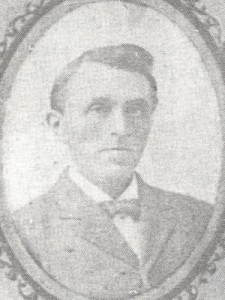
Willem van Wijk
Born: May 4, 1849 in Genderen, NL
Died: May 1, 1917 in Pella, IA USA
Father: Johan van Wijk (1817 - 1888)
Mother: Hendrina van der Beek
Willem van Wijk immigrated to the United States of America from the Netherlands on July 26, 1892. When he died in 1917, he left behind 14 sons, 3 daughters, and the five children from his second wife's first marriage. His 17 children would end up giving Willem over 1,600 decendents, all residing within the United States, and mostly in the state of Iowa.
|
|
Spouse #1:
Trijntje van den Heuvel (1853 - 1893)
Children from Marriage #1:
Johan van Wijk (John)
Dirk Johan (Dick)
Hendrika
Gijsbert Hendrikus (Guy)
Marius (Marion)
Lambert van Wijk (Bert)
Johan Willem (John Will)
Hendrikus Hohannes (Henry John)
Willem (Will)
Alettinus (Tenis)
Casper Hendrik (Harry)
Cornelius (Neal)
|
Spouse #2:
Toike Tiechlaar Bontekoe (1864 - 1915)
Children from Marriage #2:
Irene
Ben
Gerrit Joe
Joe Gerrit
Tillie
Children from 2nd wife's 1st Marriage:
Peter Bontekoe
Teunis Bontekoe
Robert Bontekoe
Dora Bontekoe
Jerry Bontekoe
|
Immigration to America; The Van Wyk Family Experience
Willem van Wijk (William Van Wyk) was born in Genderen, Netherlands on May 4, 1849. He was the fifth child of Johan and Hendrina van der Beek van Wijk. During the year 1873, Willem moved to the Harlemmermeer area and worked as foreman on the De Haan farm. On February 2, 1873, he married Trijntje van den Heuvel. Trijntje was born on December 28, 1853 and is the daughter of Dirk Johan and Hendrika Boll van den Heuvel. In June of 1892, William and Trijntje and their family emigrated to America and lived on a farm near Galesburg, Jasper County, Iowa. Their ten children, all of whom were born at Haarlemmermeer, Netherlands emigrated with them. Willem, their ninth child, also had a twin brother who died at birth. On October 18, 1893, one year after they came to America, another child was born to William and Trijntje and they named him Cornelius (Neal) Van Wyk. They now had eleven sons and one daughter. A few months after Neal's birth, his mother, Trijntje, became ill and died on December 28, 1893, her fortieth birthday. She was buried in Hewitt Cemetery, West of Sully, Jasper County, Iowa.
Nine years later, in 1902, William again took a wife. He married Toike (Tillie) Tiechlaar Bontekoe, the widow of D.B. Bontekoe of the Netherlands. Tillie Bontekoe was born in the Netherlands on February 22, 1864. Following the death of her first husband, D.B. Bontekoe, she had come to America in 1899 with her five children. Some time later the name "Bontkoe", which means spotted cow in Dutch, was changed to "DeBont". The names of the five children were Peter, Teunis, Robert, Dora and Jerry. Dora died while still in her teen years. Jerry suffered injuries from being gassed in World War I and died a few short years later. Peter, at the age of ninety-five in 1991, still resided in Denver, Colorado. It is not known if he is still alive today.
The children of William Van Wyk and his first wife, Trijntje, were step-brothers and step sisters to the DeBont children; the children of William and his second wife, Tillie, were half-brothers and half-sisters to the DeBont children; and the children of the first and secon dmarriages of William were half-brothers and half-sisters to each other.
Tillie, the second wife of William, became ill and died at the family hame at Pella, IA on April 8, 1915. The little daughter Tillie died a few weeks later on May 5, 1915 at the age of six years. they are both buried in Braceland Cemetery, north of Pella, Marion County, Iowa. Jerry and Dora are also buried there. William became ill with cancer and could no longer keep the home together for his children. He died on May 1, 1917 at the home of his daughter, Hendrika Lanser, near Sully, IA. He had been cared for there during the last days of his illness. William was buried beside his first wife in Hewitt Cemetery, Jasper County, Iowa on his sixty-eighth birthday. Below is a photograph of the twelve children of William's first marriage. The photo was taken at the Lanser farm near Sully, Iowa following the funeral of William Van Wyk.
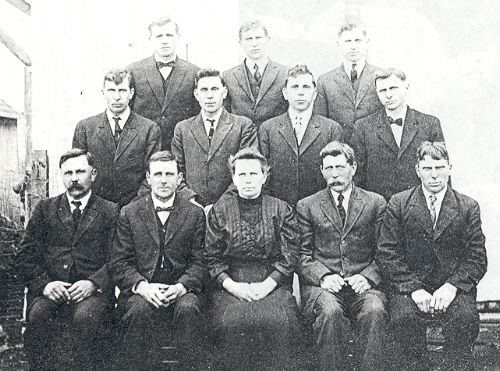
Third Row, Left to Right: Tenis, Harry, Neal
Second Row, Left to Right: Bert, John Will, Henry, Will
Front Row, Left to Right: John, Dick, Hendrika, Guy, Marion
(Seating arrangement was according to age, beginninig with the oldest.)
Following the breakup of their home because of the illness of their father, the young children of William and Tillie Van Wyk were cared for in the homes of their older siblings.
Willem Van Wijk's decision to emigrate to the United States was undoubtedly influenced by economic factors. His family was not particularly poor, but the surging Dutch population in the Netherlands left not only little work to be found, but few places to actually live. When Willem emigrated to America in the summer of 1892, many others from Holland were also making their way to Kansas, Michigan, South Dakota, Colorado, and Iowa.
While most emigrants to America would come alone and look for work before bringing the rest of the family over, Willem had sufficient money to bring his wife and eleven children over all at the same time on July 26, 1892. The family of Willem van Wijk came over on the steamship Veendam, and the original manifest listing their names is shown below.

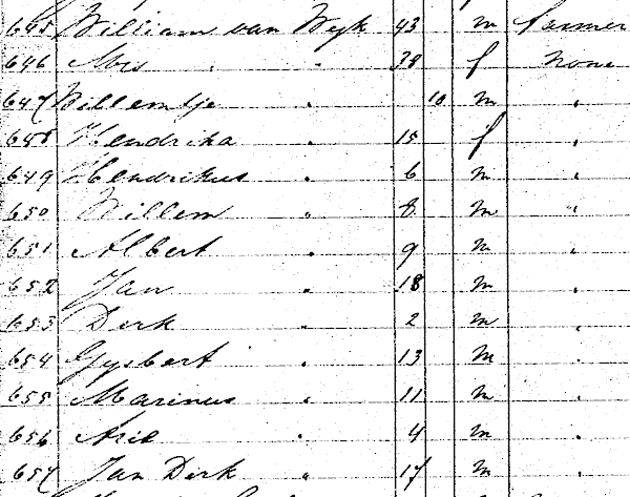
Another interesting piece of history is something else the original ship manifest listed. In addition to their names, ages, occupations was their intended destination and how many pieces of baggage they had. As I looked through the various manifests it occurred to me that most people, even those with large families, only had between two and five pieces of luggage listed on the manifest. Different from this average, Willem had fourteen pieces of registered luggage. This fact might demonstrate that Willem was not particularly poor as many of the immigrants were.

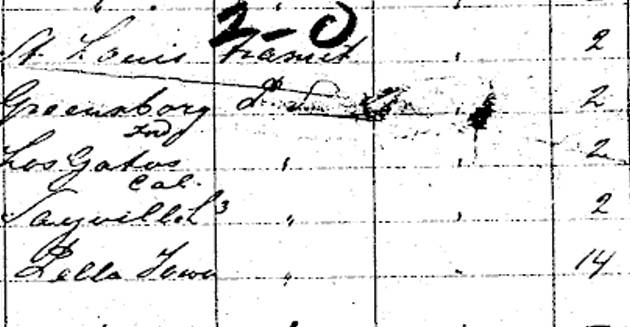
The manifest shows that his intended occupation was as farmer. Willem knew that Iowa was good farm land from reports of others whom had emigrated before him, and so his decision to move to Iowa was no doubt influenced by that fact. Pella also would provide a home and environment where his family would be around a familiar culture and language, as almost one hundred percent of the inhabitants of Pella were Dutch. Upon arriving in Pella, Iowa, Willem bought a farm that he and his family worked on for many years.
Another interesting element to the story is that of how the van Wijk spelling changed to that of van Wyk. While most historical records show the spelling as being van Wijk, the first known change is that of the manifest of the steamship Veendam, which lists Willem van Wijk's name as being William van Wyk. Willem no doubt decided to keep the spelling the Americans had given him, as he was going to spend the rest of his life in America. It is doubtful that Willem ever really learned the English language due to the fact that everyone in the Pella area spoke Dutch. It was probably more difficult for non-Dutch speaking persons to live in that area during that period of time. Even Willem's grandson, Cornelius Van Wyk (my great-grandfater), often reverted back to the Dutch language torwards the last days of his life that I remember.
Back To Main Page
|
|